Maximizing the Likelihood of doing Great Work
A general attempt at finding truth and extreme performance, not to be taken as a prescription
This is an attempt to reason from first principles about how to maximize the likelihood of doing exceptional work.
The objective is to understand the underlying principles of achievement, discovery, opportunity selection, and leverage, not to prescribe a particular life path. It is an exploration of what might be true and what enables extreme performance, not a set of instructions for how one ought to live.
The arguments are intended to be questioned, refined, and updated in light of better reasoning and evidence.
Objective
Maximize the probability of producing exceptional, consequential work. That is, work that meaningfully advances human knowledge, solves important problems, or changes the world for the better. Under the assumption that the person cares about impact on short-term and long-term timescales.
1. Start From First Principles
Suppose your goal is to accomplish something extraordinary.
At the most basic level, your success depends on three things:
- Opportunity: What problem are you working on, and how much potential does solving it have?
- Capability: How well-equipped are you to solve that problem?
- Execution: How effectively do you turn your abilities and ideas into real results?
It follows that maximizing your impact is not simply a matter of working harder or becoming more skilled. You must also choose what to work on.
An exceptional person working on a relatively unimportant problem may accomplish less than a similarly capable person working on a problem with much greater potential.
Therefore, opportunity selection is itself a critical part of doing great work. [1]
2. The Problem of Unknown Unknowns
Imagine trying to find the most valuable opportunity you could possibly pursue.
There are thousands of fields, millions of problems, and countless potential discoveries and inventions. You cannot evaluate all of them.
We can distinguish between three kinds of knowledge:
- Known knowns: Things you know and understand.
- Known unknowns: Things you know you don't understand.
- Unknown unknowns: Things you don't even realize exist or are possible.
The third category is particularly important.
You might be completely convinced that you've found an extraordinary opportunity. But your confidence only reflects the information and experiences you've accumulated so far.
Being certain that you've found a great opportunity does not mean you've found the greatest opportunity available to you.
Some of the most consequential problems you could work on may not even be imaginable from your current position.
3. Local Optima and the Danger of Premature Commitment
Consider a search algorithm navigating a tree of possibilities.
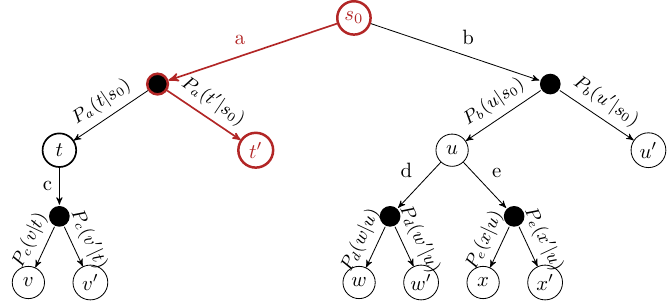
Each branch represents a decision, and each decision reveals new possibilities.
If the algorithm finds a promising branch and commits to exploring it exclusively, it may discover something valuable. However, it may never discover another branch that leads to a dramatically better outcome.
A related concept is a local optimum, a solution that is better than nearby alternatives but not necessarily the best solution overall.
Imagine climbing a mountain in thick fog. You reach the top of a hill and conclude that you've reached the highest point. But somewhere beyond the fog stands a mountain ten times taller.
The same problem exists in life.
A talented entrepreneur might discover an opportunity to build a successful company, commit to it, and become extraordinarily wealthy. Yet that person might have possessed the ability to make a far more consequential contribution in another field.
The issue is not that building a merely successful company is bad. It is that early success can prevent the discovery of substantially greater possibilities.
This is a central problem studied in research on exploration, organizational learning, and complex landscapes of possible solutions. [2, 3]
4. The Hidden Opportunity Cost
Every decision has an opportunity cost, the value of what you give up by choosing one option over another.
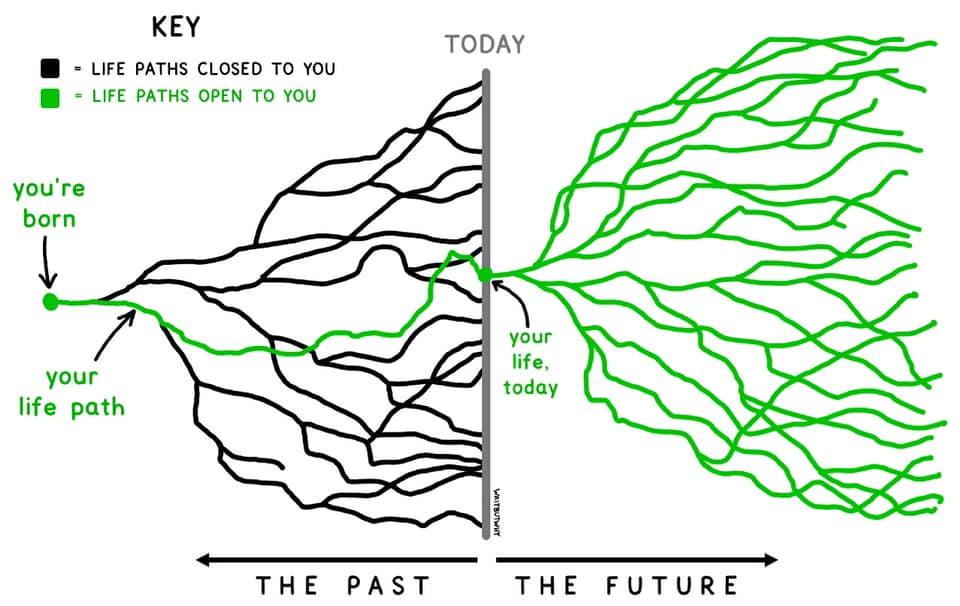
Normally, we compare the opportunities we already know about.
But what if the most valuable alternative is something we haven't discovered?
A person could spend decades successfully pursuing one goal without ever learning that they could have accomplished something far greater.
This suggests that opportunity cost extends beyond the alternatives currently visible to us.
The greatest opportunity you sacrifice may be one you never discover.
This doesn't mean an unknown alternative is necessarily better. It means that evaluating only familiar alternatives can systematically overlook the potential value of discovery.
5. Exploration Expands What Is Possible
Exploration means investigating unfamiliar fields, ideas, technologies, and problems instead of committing all your resources to an existing direction.
Exploration creates value in two ways.
First, it expands the set of opportunities you can recognize. Learning physics, computer science, biology, or economics may expose you to problems and connections you couldn't previously imagine.
Second, it increases your ability to evaluate those opportunities.
This is where first-principles thinking becomes important. Rather than accepting conventional assumptions about what is valuable or possible, you reason from fundamental facts and constraints.
Different fields also provide different mental models. Combining them can reveal possibilities that specialists working within a single discipline overlook.
Historical Examples
Steve Jobs: Calligraphy and Personal Computing
After dropping out of Reed College, Steve Jobs attended a calligraphy course simply because he found it fascinating. He learned about typefaces, spacing, and what makes typography beautiful.
At the time, this knowledge had no apparent relevance to his future career.
A decade later, when Apple was developing the Macintosh, Jobs drew upon that experience to help shape the computer's typography.
The broader lesson is that knowledge whose future applications are invisible today can become unexpectedly valuable tomorrow.
Jobs explicitly reflected on this in his 2005 Stanford commencement address. [6]
Demis Hassabis: Video Games, Neuroscience, and Artificial Intelligence
Demis Hassabis began his career developing video games. Rather than remaining exclusively in game development, he pursued computer science and later studied neuroscience, seeking to understand how the human brain produces intelligence.
These interests eventually converged in DeepMind, which he cofounded in 2010. Its research brought together ideas from neuroscience, machine learning, mathematics, engineering, and other disciplines.
DeepMind subsequently developed AlphaGo and AlphaFold, with Hassabis sharing the 2024 Nobel Prize in Chemistry for work on protein structure prediction.
His path illustrates how knowledge from apparently separate disciplines can combine to create an entirely new direction for research and entrepreneurship.
The important insight is not simply that Hassabis knew many things, but that his understanding of several fields helped him approach the problem of intelligence differently. [7]
Claude Shannon: Mathematical Logic and Electrical Engineering
In the 1930s, engineers designed complicated electrical switching circuits using physical components such as relays.
Claude Shannon recognized an extraordinary connection.
Electrical switches have two states, on and off. Mathematical logic also deals with two states, true and false.
Shannon realized that Boolean algebra, originally developed for reasoning about logic, could be used to describe and simplify electrical circuits.
His master's thesis established a powerful mathematical foundation for digital circuit design.
What appeared to be two separate fields contained the same underlying structure. Recognizing that connection opened an entirely new way of solving engineering problems. [8]
Jennifer Doudna: Curiosity-Driven Biology and Gene Editing
Jennifer Doudna's research initially focused on RNA, a molecule involved in how cells store and use genetic information.
Her curiosity eventually led her to study CRISPR, a system bacteria use to defend themselves against viruses.
At first, understanding this system was a question in basic biology, not an attempt to build a revolutionary medical technology.
Working with Emmanuelle Charpentier, Doudna helped establish how CRISPR-Cas9 could be programmed to cut DNA at chosen locations, enabling a powerful method of gene editing.
They received the 2020 Nobel Prize in Chemistry.
A fundamental scientific question revealed a technological possibility that was not the original purpose of the investigation. [9]
The General Principle
These examples illustrate different mechanisms through which exploration can create extraordinary opportunities:
- Jobs acquired knowledge whose future usefulness was initially invisible.
- Hassabis combined expertise across disciplines to pursue a broader technological ambition.
- Shannon recognized a common structure connecting previously separate problems.
- Doudna's curiosity-driven research helped uncover a powerful new technology.
None of these examples proves that exploration always produces better outcomes, and none implies that sustained specialization is unnecessary. Each breakthrough also depended on substantial technical depth and execution.
But together they demonstrate an important possibility.
The value of exploration is not limited to finding better answers to questions you already have. It can reveal entirely new questions, opportunities, and capabilities that you previously did not know existed.
Thus, exploration is not merely a response to uncertainty. It is a way to expand the space of possibilities you are capable of perceiving. [1, 3, 4]
6. Capability and Leverage Compound
Exploration has another benefit. While searching for opportunities, you can simultaneously become more capable of exploiting them.
Consider the following forms of leverage:
- Intellectual leverage: Knowledge, intelligence, judgment, creativity, and diverse perspectives allow you to recognize and solve problems more effectively.
- Technical leverage: Skills, tools, software, and systems allow you to accomplish more with the same effort.
- Social leverage: Reputation, credibility, relationships, and access to talented people expand what you can accomplish.
- Financial leverage: Capital gives you the resources to pursue opportunities that would otherwise be inaccessible.
Leverage means increasing the impact of your effort through capabilities or resources that multiply what you can accomplish.
These advantages can compound, meaning that earlier gains help generate further gains.
For example:
Knowledge → Better judgment → Better projects → Demonstrated results → Greater credibility → Better collaborators and opportunities → Further knowledge and capability.
Naval Ravikant emphasizes specific knowledge, accountability, judgment, and leverage as foundations for creating wealth. Taking responsibility for real outcomes can establish the credibility that makes greater leverage accessible. [5]
Importantly, leverage is not limited to money, employees, or distribution. Intelligence and perspective are themselves powerful forms of leverage.
And much of this leverage can be accumulated through research, experimentation, and building long before committing to a particular company or lifelong pursuit.
The Maximally Prepared Founder
Imagine a hypothetical founder who has spent years deliberately accumulating these advantages before committing to a company.
What might this person look like?
Exceptional technical ability. They possess deep expertise in several important areas, can learn unfamiliar subjects quickly, and have the skills to build sophisticated technologies themselves.
Exceptional judgment and perspective. They understand multiple disciplines, reason from first principles, challenge conventional assumptions, and recognize connections and opportunities that others overlook.
A track record of execution. They have repeatedly built difficult things, conducted meaningful research, solved real problems, and demonstrated an ability to turn ideas into results.
Credibility and reputation. Their previous accomplishments have established trust. Exceptional people recognize their competence, making it easier to attract collaborators, recruit talent, and obtain resources.
A powerful network. They have relationships with exceptional researchers, engineers, founders, investors, and other people who can help them solve problems and access opportunities.
Financial independence and capital. They possess enough resources to take substantial risks, pursue ambitious projects, and make long-term decisions without being constrained by immediate financial needs.
Distribution and technological leverage. They have access to audiences, communities, computational resources, software, and other tools capable of multiplying the impact of their work.
Agency and accountability. They are willing to make difficult decisions, take responsibility for outcomes, act under uncertainty, and commit intensely when they recognize a compelling opportunity.
Now imagine that this person discovers an extraordinary problem worth solving.
They possess not only the insight to recognize the opportunity, but also the technical ability, resources, credibility, relationships, and judgment needed to pursue it.
Compare this with someone encountering the same opportunity without these accumulated advantages.
The difference is not necessarily the quality of the idea, but the probability and scale of successful execution.
The Compounding Advantage
Importantly, these capabilities are not independent.
Greater technical ability enables better projects. Better projects produce stronger evidence of competence. Credibility attracts better collaborators. Better collaborators enable more ambitious projects. Financial resources create freedom to pursue opportunities. Diverse knowledge improves the ability to recognize them.
This creates a potentially self-reinforcing cycle.
The stronger your capabilities and leverage become, the greater the opportunities you can recognize, access, and execute.
This suggests that the value of exploration extends beyond discovering what to work on. It can also increase the impact you are capable of producing once you commit.
However, the maximally prepared founder is a theoretical ideal, not a prerequisite for starting a company. Many of these advantages are developed most effectively through founding itself, and waiting indefinitely to accumulate them can become counterproductive.
The objective is not to become perfectly prepared before acting. It is to maximize readiness without sacrificing opportunities whose value already justifies commitment.
Readiness, Not Age
None of this implies that one must be older to accomplish exceptional work.
The relevant variable is not age, but how well-positioned an individual is to recognize and execute a particular opportunity.
A young founder with exceptional technical insight, relevant capabilities, and access to a timely opportunity may be substantially better positioned than someone decades older.
Moreover, readiness is relative to the opportunity. Different problems require different capabilities, resources, and forms of leverage.
The objective is therefore not to accumulate experience for its own sake, nor to delay commitment until some arbitrary age.
It is to maximize one's ability to recognize and exploit extraordinary opportunities, regardless of when they emerge.
Sometimes the optimal moment to commit is at 18. Sometimes it is at 35. What matters is the opportunity, one's readiness to pursue it, and the cost of waiting.
7. But Exploration Has a Cost
There is an important counterargument.
Focused execution compounds too.
Someone who spends five years deeply building in one field may develop expertise, relationships, products, and insights that someone constantly switching fields never acquires.
Exploration can reveal better opportunities, but it also consumes time that could have been spent exploiting an existing one.
This creates the classic exploration versus exploitation tradeoff:
- Exploration: Discover new possibilities and improve future decisions.
- Exploitation: Concentrate resources on an existing opportunity and extract its potential.
Neither is universally superior. [2]
Even the tree-search analogy works in both directions. Exploring too few branches risks missing better opportunities. Exploring too many without going deeper risks never reaching the valuable discoveries hidden within a branch.
Therefore, the objective cannot be exploration for its own sake.
8. Deriving the Strategy
We can now assemble the argument.
- Great work requires both exceptional capability and a sufficiently valuable opportunity.
- The space of possible opportunities is far larger than what any individual currently knows.
- Premature commitment can prevent the discovery of superior opportunities.
- Exploration can reveal those opportunities while simultaneously developing capability and leverage.
- These accumulated advantages can reinforce one another, improving one's ability to act on future opportunities.
- However, continued exploration sacrifices the compounding benefits of focused execution.
Therefore, exploration is preferable when its expected benefits from discovery and capability development exceed the opportunity costs of delaying commitment.
Conversely, when the benefits of concentrating on a sufficiently compelling opportunity outweigh those of continued exploration, commitment becomes preferable.
The difficult part is that these benefits cannot be known precisely in advance. This is a framework for making better decisions, not an algorithm that guarantees the best decision.
Conclusion
The objective is not merely to become exceptional at executing an opportunity, but to maximize the probability of discovering and executing an exceptional opportunity.
Explore broadly enough to avoid premature convergence. Develop the technical depth, intelligence, and perspectives necessary to recognize possibilities others miss. Build real things to compound knowledge, judgment, credibility, and leverage.
Then, when an extraordinary opportunity emerges, concentrate those advantages on pursuing it.
Do not mistake early success for global optimality.
References
-
Paul Graham (2023). How to Do Great Work. Finding promising problems, developing exceptional ability, curiosity, and the importance of working on the right things.
-
James G. March (1991). Exploration and Exploitation in Organizational Learning. The tradeoff between discovering new possibilities and exploiting existing knowledge.
-
Daniel A. Levinthal (1997). Adaptation on Rugged Landscapes. Local optima, complex search spaces, and how concentrating on existing solutions can prevent the discovery of better alternatives.
-
Lu Hong & Scott E. Page (2004). Groups of Diverse Problem Solvers Can Outperform Groups of High-Ability Problem Solvers. A mathematical model showing how diverse perspectives and problem-solving approaches can improve collective performance under certain conditions.
-
Naval Ravikant.
On accumulating specific knowledge, judgment, credibility, accountability, and leverage to multiply the impact of one's work.
-
Steve Jobs (2005). Stanford Commencement Address: You've Got to Find What You Love. Jobs explains how studying calligraphy out of curiosity later influenced the Macintosh's typography.
-
The Royal Society. Demis Hassabis: Biography. Documents Hassabis's journey from video game development through neuroscience and artificial intelligence to cofounding DeepMind.
-
Claude E. Shannon (1938). A Symbolic Analysis of Relay and Switching Circuits. Shannon's foundational work connecting Boolean algebra to electrical switching circuits, establishing principles underlying digital circuit design.
-
The Royal Swedish Academy of Sciences (2020). The Nobel Prize in Chemistry 2020: Scientific Background. How fundamental research into bacterial immune systems led to the development of programmable CRISPR-Cas9 gene editing.
The argument synthesizes established ideas from decision-making, organizational learning, and entrepreneurship. It does not establish empirically that delaying commitment is optimal for every individual.